
|
Getting your Trinity Audio player ready...
|
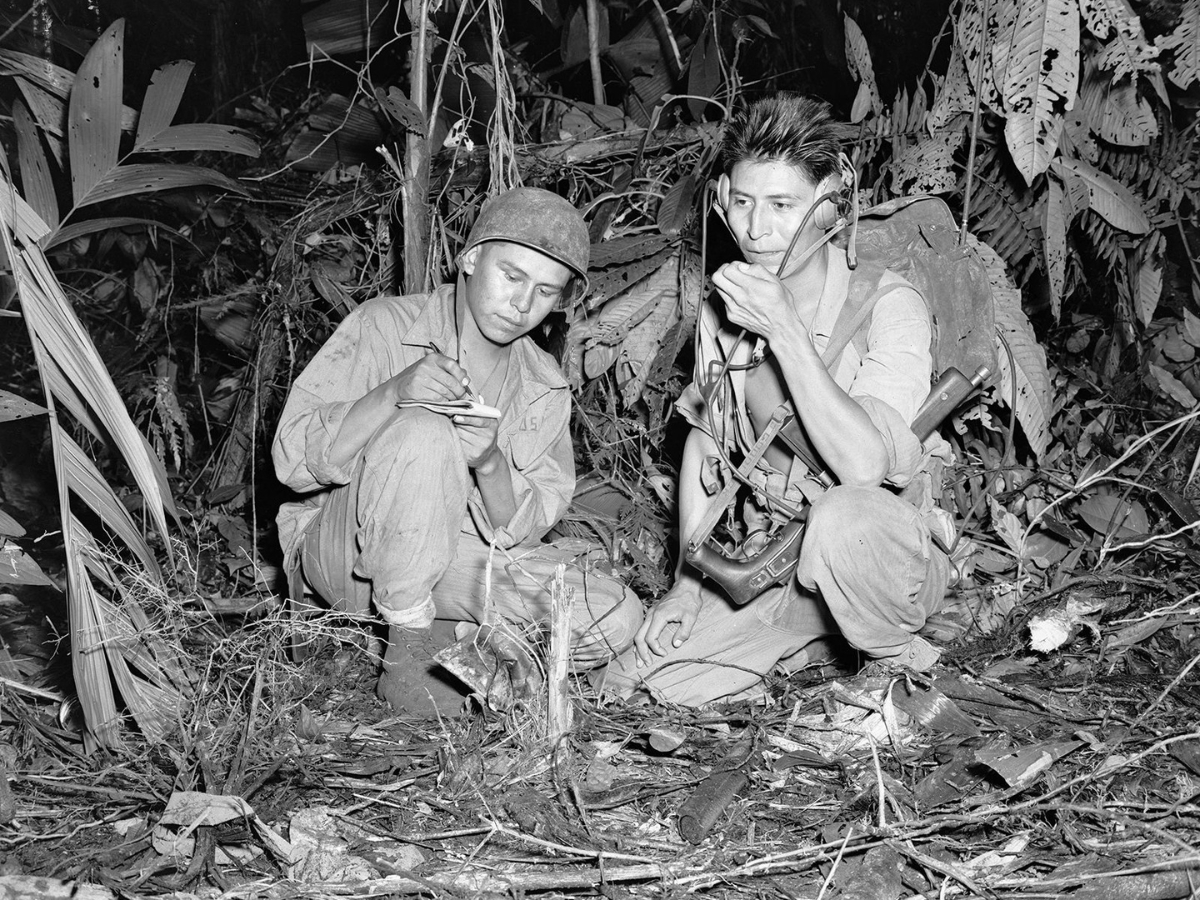
The Navajo Code Talkers hold a unique and invaluable place in American history, embodying both the resilience of Indigenous peoples and the strategic brilliance that contributed to the Allied victory in World War II. These Native American Marines created and implemented an unbreakable code based on the Navajo language, which allowed secure and rapid communication in the Pacific Theater. Despite their extraordinary service, these heroes returned to a nation that continued to marginalize Indigenous communities, failing to recognize their contributions for decades. While there has been progress made in highlighting their stories, the longstanding struggle to gain rightful acknowledgment for their sacrifices is emblematic of a larger issue in current American history—the systemic erasure of Native contributions.
This erasure has not ended. In early 2025, the Pentagon initiated a comprehensive removal of content related to Diversity, Equity, and Inclusion (DEI) from its websites and social media platforms. This action was taken in compliance with an executive order from President Donald Trump aimed at dismantling DEI initiatives within federal agencies. The purge led to the deletion of numerous articles and profiles celebrating the contributions of historically underrepresented groups, including the Navajo Code Talkers. The decision, met with swift backlash from Indigenous leaders, veterans, historians, and the public, highlighted the fragility of Indigenous visibility in national narratives and how such history can be causally erased at the behest of political ideologies.
This incident is part of a larger pattern where the current administration’s anti-DEI stance has resulted in the suppression of other minority histories. For example, content related to the Tuskegee Airmen, the first African American military aviators, was also removed from military websites. Similarly, profiles of other notable minority service members, including Medal of Honor recipients, were deleted, raising concerns about the deliberate omission of significant historical achievements by servicemen and women of color.
The Pentagon eventually reinstated the materials following widespread criticism, but the incident revealed a troubling readiness to discard Native contributions, as well as other minority groups, when they become politically inconvenient. It also reinforced the idea that honoring Indigenous history remains conditional, vulnerable to shifting ideological tides rather than grounded in a firm commitment to historical truth. When such policies prioritize a narrow, Euro-American-centric perspective, they fail to acknowledge the diverse and multifaceted nature of the nation. This oversight ultimately prevents the recognition of the full spectrum of individuals who have shaped its past and their significant contributions to its history, including that of the Navajo Code Talkers.
The Navajo Code Talkers’ role in World War II arose from the urgent need for secure military communication. Standard codes used by the U.S. military were frequently intercepted and deciphered by Axis powers, jeopardizing critical operations. In search of a solution, the Marine Corps turned to the Navajo language—a complex, unwritten, and largely unfamiliar tongue outside of the Navajo Nation. The idea to use Navajo speakers as military communicators was first proposed by Philip Johnston, a World War I veteran who had been raised among the Navajo and was one of the few non-Native speakers fluent in the language. He was aware that Indigenous languages had been used in the past as secure codes for communications, particularly throughout World War I.
During World War I, Native American soldiers from the Cherokee, Choctaw, and Lakota nations were among the first to use their Indigenous languages as a tactical advantage in secure military communications. One of the earliest and most notable examples occurred in 1918, during the Meuse-Argonne Offensive, one of the largest operations of the American Expeditionary Forces. The U.S. Army enlisted Choctaw soldiers to transmit coded radio and telephone messages in their native language. These men, later recognized as some of the first “code talkers,” successfully relayed critical information about troop movements and artillery locations, effectively confusing German intelligence, which was unable to decipher the unfamiliar language. Similarly, Cherokee and Lakota soldiers were also recognized for using their native tongues in battlefield communications. Although these early efforts were not part of a formal program, they laid the foundation for what would later become the renowned Navajo Code Talkers initiative during World War II.
Recognizing the suggestions from Johnston, the Marine Corps recruited 29 Navajo men to develop a code that would prove to be one of the most significant cryptographic achievements in military history. By the time World War II erupted, the U.S. military recognized the strategic potential of Indigenous languages and formalized Code Talking programs. The program would go on to expanded significantly, involving not only the Navajo but also members of the Lakota, Meskwaki, Mohawk, Comanche, Tlingit, Hopi, Cree, and Crow nations. These Code Talkers served across the Pacific, North African, and European theaters, using their languages to transmit messages that confounded enemy forces. The Navajo Code Talker program became the most known, thanks to its complexity—the code was never broken.
The Navajo Code Talkers devised an intricate system in which words from their language represented military terms, often using poetic and culturally significant references. For example, the Navajo word for “turtle” was used to signify a tank, while “chicken hawk” represented a dive bomber. This system enabled the transmission of complex messages at remarkable speed—faster than encrypted machines and entirely indecipherable to enemy forces. Their work proved instrumental in major battles such as Guadalcanal, Saipan, and most notably, Iwo Jima, where they relayed over 800 messages in the span of two days without error. Military commanders credited them with significantly contributing to American success in the Pacific, yet upon returning home, these heroes faced discrimination and were largely ignored by mainstream historical narratives for decades.
It was not until 1968 that the existence of the Navajo Code Talkers was declassified, and even then, recognition came slowly. It took until 2000 for the U.S. government to formally honor them with Congressional Gold and Silver Medals. While this acknowledgment was an important step forward, it reflected a broader trend of Native American contributions being overlooked or only recognized long after their impact had been felt. Many widely viewed documentaries, such as Ken Burns’ The War and the History Channel’s WWII in HD, highlight iconic events like D-Day, the Battle of the Bulge, and the liberation of Nazi concentration camps. While these events are undoubtedly significant, they often come at the expense of a fuller, more inclusive retelling of American military history. When the Navajo Code Talkers are mentioned, they typically receive a brief acknowledgment, lacking the depth and context that their extraordinary story deserves. The failure to fully incorporate the history of the Navajo Code Talkers into mainstream American education and historical discourse remains a glaring omission—one that is only exacerbated by current policies that suppress discussions of racial and historical inequalities.
The Trump administration’s recent approach to DEI initiatives was one of direct opposition and dismantlement. The effects of such policies extended beyond mere rhetoric. Federal funding for Indigenous programs was slashed, and efforts to integrate Native American history into education faced increasing resistance. The Trump administration’s push to curtail historical discussions related to racial inequality directly undermined efforts to amplify the stories of figures like the Navajo Code Talkers. This erasure is not incidental—it is part of a broader pattern of minimizing the roles of marginalized communities in American history, reinforcing a version of the past that prioritizes certain narratives as unequivocally and definitively American while disregarding others.
By refusing to engage with difficult truths, America risks furthering fostering a society that lacks both historical accountability and an appreciation for the diverse contributions that have shaped it. The continued suppression of Indigenous narratives represents a dangerous precedent that weakens the very fabric of American historical consciousness. The Navajo Code Talkers’ contributions serve as an example of immense patriotism, yet their legacy remains threatened by policies that publicly diminishes their role in history. Recognizing their sacrifices is not merely an act of historical justice but a necessary step in ensuring that the nation’s history reflects the contributions of all its people. The Navajo Code Talkers should not be relegated to footnotes in history books or erased; they deserve to be central figures in the narrative of American resilience and heroism.

Miguel Douglas is the executive director of American Indian Republic and is an enrolled member of the Puyallup Tribe of Indians. He has written extensively on Indian gaming and its effects on American Indian communities. He has received a Master’s Degree in Interdisciplinary Studies from the University of Washington.

Christy Hanson
April 4, 2025 at 10:04 am
Hear, hear!
Miguel Douglas
April 4, 2025 at 10:31 am
Thanks Christy, definitely!
Christy
April 4, 2025 at 10:34 am
I’ll be protesting Saturday in Gallup. Also, the Navajo president is a crook and a Trumper who wants to get an office in D.C., but is spending way too much to get it when he could be moving needed projects forward in our tribe, especially San Juan area agricultural projects–that 30-year old broken water pump and the bureaucratic, ineffective (and possibly nonexistent) farm permits have got to go!
Larry Potter
April 4, 2025 at 5:35 pm
I was a USMC 1969,to1971 served 70 to 71 I’m against and kind of destroying the DEI that’s ungodly same if it had been for the code talkers defend this country I’m American Indian God bless our native land