
|
Getting your Trinity Audio player ready...
|
Throughout the narrative of American history, various unjust reasons have been presented to account for the violence and land dispossession against the Indigenous population. On religious grounds, it was frequently believed that Native Americans lacked souls and could be killed without moral consequence. On the understanding of land, it was perceived that Native Americans were incapable of effectively utilizing the resources of the land in the same manner as European settlers, and therefore should be replaced as the caretakers of those resources by the settlers. Various factors, including these and more, have been employed at different times throughout history to validate the destructive actions taken by European settlers against Native Americans, many of which persist even to this day.
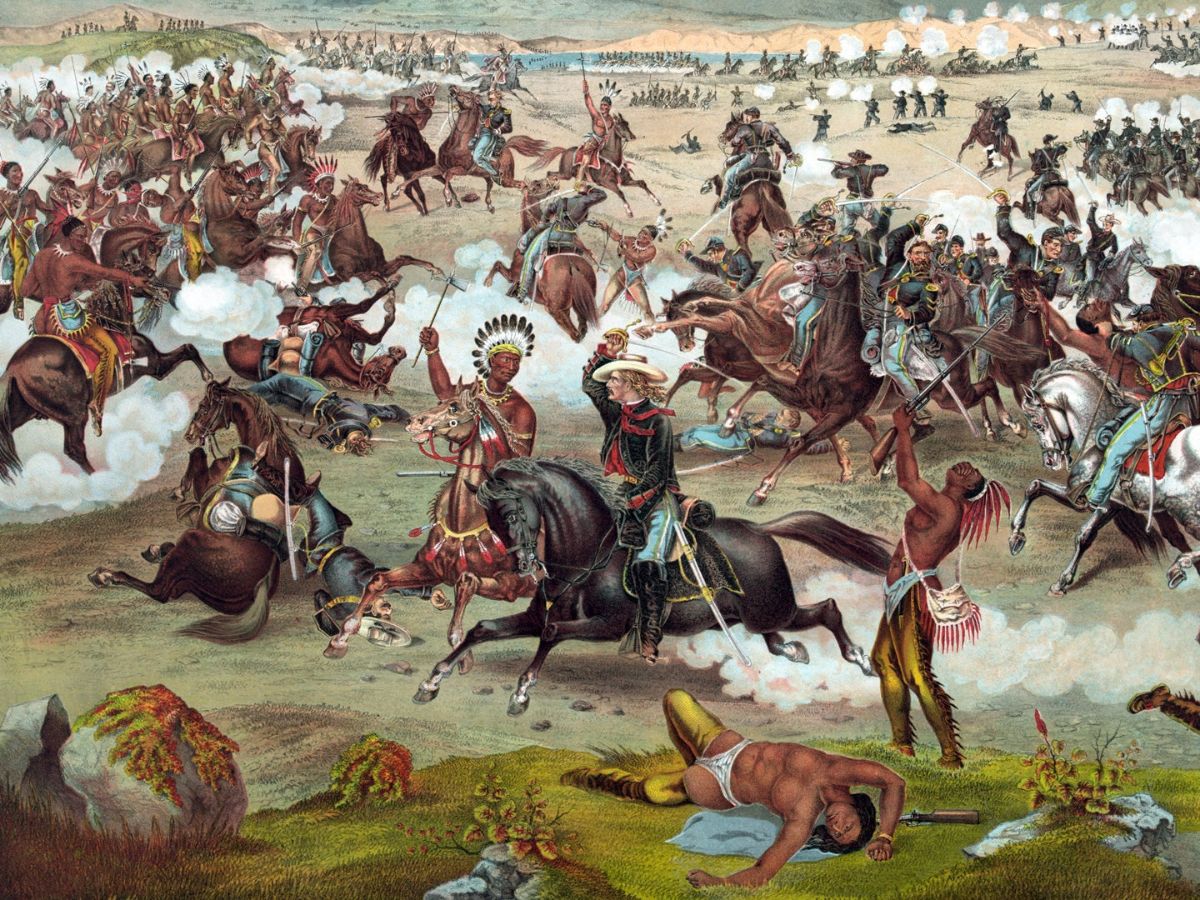
However, one of the most significant reasons used to justify the barbarity inflicted upon the Indigenous population was their inherent “warlike nature,” which was attributed to centuries of internal conflicts among themselves, long before the arrival of European settlers. This broad generalization of the Indigenous population as savage warring tribes led to the conviction that European settlers were simply defending themselves, and thus, it was morally acceptable for them to engage in similar violent conflicts to defend against the hostile Indigenous population. The term “savage” was employed by European settlers to describe Indigenous people as lawless and uncivilized, perceiving them as lacking civilization rather than acknowledging their diverse yet equally functional structures, which were based on communal, non-capitalist systems and had distinct land ethics.
This ahistorical analysis erroneously portrays the entire Indigenous population as inherently violent and aggressive, even before contact with European settlers. This distorted narrative justifies the excessive force used by European settlers against them and serves as a justification for forcibly removing them from their ancestral lands. By portraying Indigenous societies as inherently violent, this narrative distorts their complex cultures and governance systems, which often involved extensive trade networks and sophisticated conflict resolution strategies. Moreover, this portrayal absolves European settlers of their own acts of violence, framing their conquests as necessary defensive measures rather than deliberate campaigns of expansion and dispossession. This misrepresentation has had lasting consequences, reinforcing harmful stereotypes that persist in historical discourse and public perception, ultimately contributing to the marginalization and erasure of Indigenous histories and voices.
While some Native American tribes undoubtedly engaged in warfare, as with many other civilizations, their conflicts were often highly structured, ritualistic, and governed by cultural codes that restricted the extent of violence. Many tribes maintained peaceful relationships that involved diplomatic alliances and intertribal marriages to promote stability and mutual prosperity. Some tribes, such as the Hopi and Nez Perce, were renowned for their pacifist traditions, while others, like the Iroquois Confederacy, developed sophisticated political systems to mediate disputes and prevent unnecessary bloodshed. Warfare, when it did occur, was often motivated by factors like territorial acquisition, resource competition, or seeking revenge for past wrongs. However, these conflicts rarely resembled the large-scale, total warfare practiced by European nations, which often sought complete domination and annihilation of their adversaries. The notion that Indigenous warfare was comparable to European warfare overlooks the fact that many Native American conflicts were cyclical and centered around rebalancing power rather than extermination. Unlike European colonial wars, which aimed at conquest and territorial expansion, Indigenous warfare often involved smaller-scale raids and conflicts resolved through negotiations, trade agreements, or intermarriage between tribes.
Consider the Haudenosaunee Confederacy, also known as the Iroquois, one of the most politically advanced societies in North America. This confederacy, comprising the Mohawk, Oneida, Onondaga, Cayuga, Seneca, and later the Tuscarora, was governed by the Great Law of Peace, which prioritized diplomacy and consensus-based decision-making. Instead of perpetuating endless cycles of warfare, they forged a political alliance that maintained stability for centuries. Their sophisticated governmental system even influenced the U.S. Constitution, showcasing their remarkable ability to establish enduring peace and cooperation among diverse groups. The existence of such advanced political structures directly refutes the prevalent myth that all Native American societies were inherently violent or chaotic. Their capacity to maintain diplomatic relations, engage in international trade, and govern through consensus demonstrates that Indigenous political systems were not only as sophisticated but often surpassed many European models of governance during that era.
Further west, the Mandan and Hidatsa peoples established agrarian societies along the Missouri River, establishing trade hubs that connected numerous tribes across the Great Plains. Their emphasis on trade and diplomacy contributed to their prosperity for centuries. These agricultural communities displayed remarkable ingenuity, developing sophisticated irrigation systems and intricate governance structures long before European contact. Despite their peaceful existence, they faced forced removals and targeted military campaigns aimed at extermination under U.S. policies intended to clear land for settler expansion. Notably, they were devastated by smallpox, also initiated by European settlers. The resilience of these societies in the face of colonization further challenges the notion that Native American groups were destined for extinction due to internal conflicts.
The Hopi, renowned for their nonviolent culture, resided in highly defensible mesa-top villages in present-day Arizona. Their agrarian society was structured around religious traditions and communal cooperation. Unlike the settler militias and armies that ruthlessly campaigned against various tribes, the Hopi rarely resorted to large-scale conflicts, opting instead for diplomacy over war. Nevertheless, despite their peaceful demeanor, they endured forced conversions and land seizures by Spanish, Mexican, and American authorities. Their resistance to colonization was not manifested through violence but through unwavering cultural and spiritual endurance, persistently preserving their traditions despite centuries of oppression. The Hopi example underscores the fact that the presence or absence of warfare had little bearing on whether Indigenous peoples faced European violence—even peaceful communities were vulnerable to conquest and forced assimilation.
In the Southeast, the Chickasaw and Choctaw established extensive trade networks that connected their societies to both Indigenous and European economies. Their societies were organized around communal land ownership, and they maintained a certain degree of autonomy through diplomatic means. However, despite their efforts to coexist with European settlers, their attempts were unsuccessful, leading to their forcible removal during Andrew Jackson’s Indian Removal Act. The Trail of Tears, a tragic consequence of settler expansion, resulted in the deaths of thousands of Indigenous people due to forced displacement, disease, and starvation. These forced removals demonstrate that European violence against Native Americans was not driven by Indigenous conflicts but rather by a systematic campaign aimed at acquiring land and erasing their cultural heritage.
The above are just a few examples of the many Indigenous communities that challenge the prevailing narrative that portrays the Indigenous population as inherently warlike prior to European contact. The idea that Native American societies were constantly at war with each other before European contact—and that this somehow justified settler violence—is an oversimplification that ignores both historical nuance and the reality of warfare across all human civilizations. If internal conflict among Indigenous peoples justified European conquest, then by that logic, the near-constant wars between European nations should have justified their own subjugation by outside forces. Yet, this argument was never applied to Europe—only to Indigenous peoples whose land and resources were being taken. European nations fought countless wars among themselves, including the Hundred Years’ War, the Thirty Years’ War, the Napoleonic Wars, and numerous dynastic conflicts that devastated entire regions. These wars were far bloodier and more destructive than many Indigenous conflicts, yet no one argued that England, France, Spain, or other warring European nations, should be conquered and dispossessed of their lands as a result.
The selective use of this argument reveals its true purpose: to justify and legitimize the violent displacement of Indigenous people while absolving European settlers of any wrongdoing. By focusing on specific aspects of history, it distorts the narrative, conveniently overlooking the severe harm caused and minimizing the responsibility of those who benefited from it. This deliberate manipulation of historical memory serves only to protect the settlers’ legacy while simultaneously preserving and elevating a narrative that unjustly simplifies the profound complexity of Indigenous people and their role in American history, reducing them to warring “savages.” This deliberate conjecturing not only perpetuates historical injustice but also hinders the healing and reconciliation that can only arise from acknowledging the complete truth of what transpired. Generalizing that all Native Americans were warlike is a grave historical misjudgment. By recognizing that numerous Indigenous societies were not inherently warlike, and that settler violence played a significant role in the violent conflicts that did occur, we can all strive to be more accurate custodians of American historical truth, ensuring that future generations have a more accurate understanding of our past.

Miguel Douglas is the executive director of American Indian Republic and is an enrolled member of the Puyallup Tribe of Indians. He has written extensively on Indian gaming and its effects on American Indian communities. He has received a Master’s Degree in Interdisciplinary Studies from the University of Washington.

Brittany
October 21, 2025 at 4:23 am
Bullshit! All of this is revisionist bull crap! You’re perpetuating the Noble Savage myth thinking you were always peaceful before Europeans came. This whole article perpetuates lies!
Miguel Douglas
October 22, 2025 at 3:16 pm
How so? Can you please elaborate and provide specific examples?
Tania moller
November 7, 2025 at 1:15 pm
many indigenous groups engaged in warfare, raids, and territorial defense. but it’s also true that these societies had sophisticated political systems, trade networks, and cultural traditions. life before european contact was complex, with both cooperation and conflict, just like any other part of human history.
Jason Marsh
July 3, 2026 at 11:52 am
There are many examples of major atrocities and massacres at the hands of many of the North American tribes. Mass graves uncovered showing mutilation both before and after a ‘raid’ ecompassing hundreds to thousands of individuals. The whole ‘stewards of nature’ myth is also not accurate. There are also records of entire forests being wiped out to make way for hunting camps, certain species of fish that were considered undesirable being purposely fished to extinction with gill nets (Which, ironically happens to this very day with the Puyallup and Muckleshoot tribes exterminating fish that prey on Salmon in the Northwest), other fauna hunted to extinction, etc. The only reason the Buffalo wasn’t hunted to extinction prior to European settlement was because there weren’t enough Native Tribes and advanced weaponry capable of doing it. Facts hurt, sometimes.
Miguel Douglas
July 3, 2026 at 9:39 pm
Jason, the biggest issue with your argument is that it makes sweeping claims without providing specific historical examples or context. Saying some Indigenous nations engaged in warfare or had environmental impacts does not prove that all Indigenous societies were destructive, it only shows they were human societies with the same complexities as everyone else. No credible historian claims Indigenous people lived in a perfect, untouched wilderness, but the evidence overwhelmingly shows that many Indigenous nations developed long-term systems of land and resource management that were far superior to Euro-Western systems. Practices such as controlled burning, selective harvesting, seasonal restrictions, and habitat management shaped North America for thousands of years and are now recognized by many contemporary researchers as effective ecological strategies.
The buffalo claim is especially inaccurate. Indigenous peoples hunted bison for thousands of years while populations remained in the tens of millions. The near extinction of bison occurred after the rise of commercial hide hunting, industrial weapons, railroads, and federal expansion policies in the 1800s, when populations dropped from roughly 30–60 million to fewer than 1,000 animals. Blaming Indigenous hunters for a collapse that happened only after massive industrial expansion ignores the historical timeline. Arguments like yours require evidence and accuracy rather than cherry-picked examples used to generalize about hundreds of distinct nations across an entire continent, which you have, ironically, proven the article’s point.